
Finite Element Method: World-Wide Acceptance
Introduction
Ray Clough (rhymes with "rough"), one of the pioneers of the finite element method, considered the conference held at Wright-Patterson Air Force Base in Ohio in 1965 on Matrix Methods in Structural Mechanics to be the event that demonstrated that the finite element method had gained universal acceptance as a tool in structural mechanics. The method went on to become a multi-disciplinary tool and its widespread adoption earned it a Library of Congress Subject Heading (Library of Congress, 2009) by 1986.
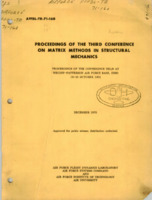
The proceedings for the conference, and two successor conferences on the same topic - which only strengthened Clough's claim of universal acceptance - were sponsored in part by the Air Force Flight Dynamics Laboratory (AFFDL) at Wright-Patterson and released as monographs in the laboratory's technical report series. All three proceedings have been indexed at the paper level and posted for public download at the Contrails website:
In recognition of role of these Air Force Flight Dynamics Laboratory sponsored conferences in creating the collegial environment in which fellow researchers could discuss the merits of the FEM, and the outlet for the presentation of some of the earliest results of the application of the method, a succinct outline of the development of the FEM is presented, with the conferences discussed in context.
Ray W. Clough
Ray W. Clough was the Byron L. and Elvira E. Nishkian Professor of structural engineering in the department of civil engineering at the University of California, Berkeley and was awarded the National Medal of Science in Engineering by President Bill Clinton in 1994 as "One of the Founders of Finite Element Method" (National Science and Technology Medals Foundation, 2025). He was part of a team that developed the method for use in aerospace applications at Boeing before spending most of his career concerned with seismic design where he employed the FEM extensively, and as such was considered the "Father of the modern FEM" by the National Academy of Engineering, who acknowledged him as "one of the world's most accomplished engineers and scientists". (National Academy of Engineering, 2016)
Finite Element Method (FEM) Explained
The basic idea in the finite-element method is to find the solution of a complicated problem by replacing it by a simpler one (Rao, 2005); it is a numerical technique that gives approximate solutions to differential equations that model problems in physics and engineering (Pepper & Heinrich, 2006).
The essence of the finite method is to partition the domain of the problem into non-overlapping elements and to provide an approximate solution that has a simple form within each element. The local representations are then patched together to form a global solution of the desired smoothness. As the local form of the solution is to be kept simple, accuracy is achieved by making the elements as small as possible; this in turn means that the approximate problem is defined by a large number of equations (Wait & Mitchell, 1985)
Finite Element Method Germination
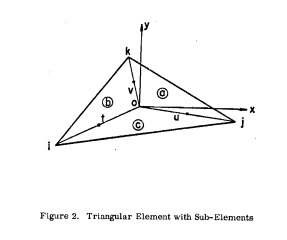
Clough's involvement in the 1952 and 1953 Boeing Summer Faculty Programs with M. J. Turner, the head of the Structural Dynamics Unit at Boeing, led to the development of the finite element method (Clough, 1990). Clough acknowledged Turner as deserving the "principal credit for conceiving the procedure" (Clough, 1990). The key breakthrough occurred during the interim between the summer sessions, during the winter of 1952-53, as Turner developed a new procedure:
The essential idea in the proposed Turner procedure was that the deformation of any plane stress element be approximated by assuming a combination of simple strain fields acting within the element. The idea was applicable to both rectangular and triangular elements, but the use of triangular elements was given greater emphasis because an assemblage of triangular elements could serve to approximate plates of any shape. (Clough, 1990)
Computer's Role
Computers were essential in performing the large number of calculations needed for applying the finite element method. Clough had what at the time was a luxury, a new IBM 701 computer, available to him starting in September 1957. He developed a Matrix Algebra Program similar to one developed by another researcher that could carry out "any specified sequence of matrix operations" and allowed for the study of the use of the Turner triangular plate elements in solving practical plane stress problems (Clough, 1990).
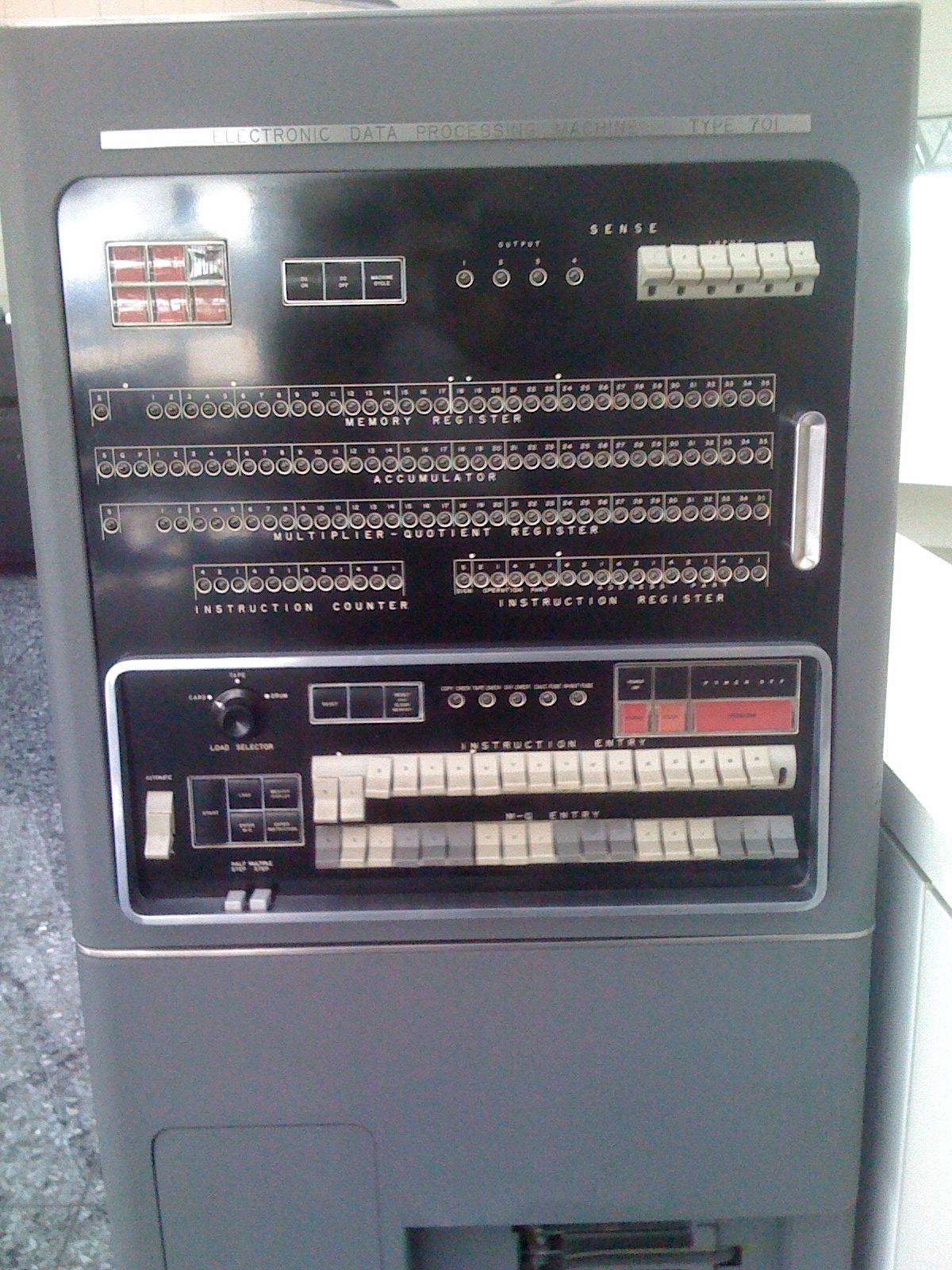
IBM 701 console
Dan CC BY 2.0, via Wikimedia Commons
Based upon the success of his initial result, Clough prepared a paper to be presented at the 2nd ASCE Conference on Electronic Computation, but the initial impact was muted:
When the paper was presented, it had essentially no impact on the civil engineering profession, mainly because the method could be applied effectively only by means of automatic digital computer, and these were not readily available to typical structural engineers. (Clough, 1990)
While Clough commented on the lack of availability of computers as a deterrent to the adoption of the FEM, others have commented that the technical limitations of the computer available to Clough at the time contributed to the muted impact of that first paper:
At that time, the only digital computer in the College of Engineering was an IBM 701 that was produced in 1951 and was based on vacuum tube technology. The maximum number of linear equations that it could solve was 40. Consequently... the course-mesh stress-distribution obtained was not very accurate. Therefore, most of the attendees at the conference were not impressed. (Wilson & Moehle, 2018).
In the development of the finite element method, there is a recurring theme of the technology needed to apply the method trailing the intellectual aspects, but fortunately, the lag between theory and application was minimal.
Coining "Finite Element Method"
In recounting the development of what would become known as the finite element method, Clough described himself as
a participant in developing the basic concepts [and] responsible for coining the name of the method. (Clough, 1990)
The paper presented at the ASCE conference in 1960 represented the first time that his chosen name of "Finite Element Method" appeared in the technical literature (Clough, 1990)
Conferences as Forums
The role of conferences played in the development of the Finite Element Method was twofold as they
allowed for formal presentations of ideas and for personal meetings between the active researchers (Clough, 1980)
In particular, an international conference in Lisbon in September 1962 offered only one paper with a central theme of FEM but
the conference provided a good forum for discussion of the relative merits of the finite difference and finite element methods in structural analysis. (Clough, 1980)
Clough's paper presented in Lisbon, at the Symposium on the Use of Computers in Civil Engineering, represented the second publication with FEM in the title (Clough, 1990). The first two publications of Clough's bearing titles with the mention of FEM were papers presented at conferences rather than articles submitted to peer-reviewed journals. These social gatherings allowed an opportunity for Clough to promote the nascent technique, and this promotion would bear fruit in a succession of Air Forces sponsored conferences.
World-Wide Acceptance
It was over a decade after the origins of what would become the Finite Element Method that Clough considered that the method, the development of which he was an integral part, had become accepted by researchers:
The rapid world-wide acceptance of the method was very evident at the 1965 Conference on Matrix Methods in Structural Mechanics held at Wright-Patterson Air Force Base, at which many papers were presented involving a wide range of applications of the finite element method. (Clough, 1990)
By 1965, when the first Conference on Matrix Methods in Structural Mechanics was held at Wright-Patterson Air Force Base, the expansion of interest in and activity with the FEM was phenomenal. This milestone event brought together from all over the world nearly all researchers who had done significant work with finite elements. At the conclusion of the conference, it was evident that FEM had come of age. (Clough, 1980)
Follow-up Conferences
The initial conference on Matrix Methods in Structural Mechanics was followed by two more in 1968 and in 1971, again at Wright-Patterson Air Force Base. The tables of contents of these two proceedings only reinforce the assertion that the Finite Element Method had "come of age". Fifteen papers of forty presented at the second conference referenced Finite Element Method in their titles (1968, December). Another twenty-two of a total of thirty-four papers referenced FEM in their title at the third conference, over two-thirds of the papers presented. (1973, December).
In the six decades since the 1965 conference that represented the confirmation of the Finite Element Method as an accepted mathematical technique, FEM has become accepted as a multidisciplinary tool, as can be seen with this illustration.
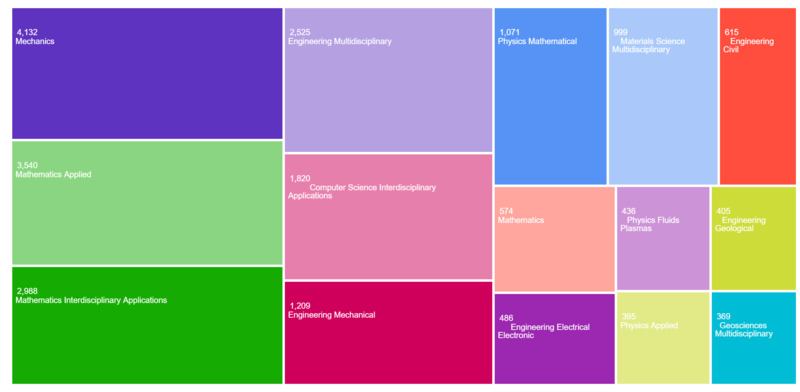
The number of publications with "Finite Element Method" as a keyword are represented, broken down by discipline.
Additionally, starting in the 1970s, books have been published to specifically teach the method, from an introductory level to broad field-specific applications and narrow sub-field applications.
FEM in the 21st Century
As the twenty-first century proceeds, the use of the technique continues spreading to emerging fields, such as nanotechnology and biomedical (Pepper & Heinrich, 2006). Indeed, Clough's original paper that led to the worldwide acceptance of the finite element method is being cited not only by researchers in his native civil engineering field (Heuer, N., 2024), but also in medicine (Abdoli, M., Mehranian, A, Ailianou, A., Becker, M. & Zaidi, H., 2016) and geochemical geophysics (Borlinghaus, M. , Neyers, C. & Brockmann, J.M., 2023) and further refined and extended by applied mathematicians (Ainsworth, M., & Parker, C., 2024), (Vlachkova, K., 2020 & 2021).
The mathematical technique coined by Mr. Clough, Finite Element Analysis, which lead to his recognition by the President of the United States, is alive and thriving sixty years after its introduction, all emanating from a thirty-page conference paper presented at a three-day scientific gathering. The paper may have had a "muted" impact in the short run but it is now clear its impact is substantial and long-lived!
References
- Abdoli, M., Mehranian, A., Ailianou, A., Becker, M. & Zaidi, H. (2016) "Assessment of metal artifact reduction methods in pelvic CT", Medical Physics, 43:1588
- Ainsworth, M. & Parker, C. (2024) "Computing H2-Conforming Finite Element Approximations Without Having to Implement C1-Elements", Numerical Algorithms for Scientific Computing, 46(4), https://doi.org/10.1137/23M161548
- Bader, R. M., Berke, L., Meitz, R. O., Mykytow, W. J., & Shirk, M. R.(Eds.) (1973, December) Proceedings of the Third Conference on Matrix Methods in Structural Mechanics, Wright-Patterson Air Force Base, Ohio, 19-21 October 1971, https://contrails.library.iit.edu/item/162914
- Berke, L., Bader, R. M., Mykytow, W. J., Przemieniecki, & Shirk, M. H. (Eds.) (1969, December) Proceedings of the Second Conference on Matrix Methods in Structural Mechanics, Wright-Patterson Air Force Base, Ohio, 15-17 October 1968, https://contrails.library.iit.edu/item/161224
- Borlinghaus, M. , Neyers, C. & Brockmann, J. M. (2023) "Development of a continuous spatiotemporal finite element-based representation of the mean sea surface", Journal of Geodesy 97:Article 16, https://doi.org/10.1007/s00190-023-01709-1
- Clough, R. W. (1960, September), "The finite element method in plane stress analysis", Proc. 2nd A.S.C.E. Conf. on Electronic Computation, Pittsburg, PA
- Clough, R. W. & Wilson, E. L. (1962), "Stress analysis of a gravity dam by the finite element method", Proc. Symposium on the Use of Computers in Civil Engineering, Laboratorio Nacional de Engenharia Civil, Lisbon, Portugal
- Clough, R. W. (1980) "The Finite Element Method After Twenty-Five Years: A Personal View", Computers & Structures, vol 12. pp. 361-370
- Clough, R. W. , (1990) "Original Formulation of the Finite Element Method", Finite Elements in Analysis and Design, v. 7 no. 2, p.89-101 https://doi.org/10.1016/0168-874X(90)90001-U
- Clough, R. W. & J. Penzien (1975) Dynamics of Structures, McGraw-Hill, New York
- Franklin Institute (2006, April) Ray W. Clough, https://fi.edu/en/awards/laureates/ray-w-clough
- Heuer, Norbert, (2024) "Generalized mixed and primal hybrid methods with
applications to plate bending", https://doi.org/10.48550/arXiv.2406.12541 - Library of Congress (2009, June 11) Finite element method https://id.loc.gov/authorities/subjects/sh85048349.html
- Pepper, D. W & Heinrich, J. C. (2006) The Finite Element Method: Basic Concepts and Applications, Taylor & Fancis, New York
- Przemieniecki, J. S., Bader, R. M., Bozich, W. F., Johnson, J. R., Mykytow, & W. J. (Eds) (1966, November) Matrix Methods in Structural Mechanics (Proceedings of the Conference held at Wright-Patterson Air Force Base, Ohio 26-28 October 1965) https://contrails.library.iit.edu/item/160931
- Rao, S. S., (2006) The Finite Element Method in Engineering, Elsevier Butterworth- Heinemann, Burlington, MA
- Vlachkova, K. (2020) "Interpolation of scattered data in R3 using minimum Lp-norm networks, 1 < p < ∞", Journal of Mathematical Analysis and Applications, Volume 485, Issue 2, 123824, ISSN 0022-247X, https://doi.org/10.1016/j.jmaa.2019.123824.
- Vlachkova, K. (2021). An Improved Algorithm for Scattered Data Interpolation Using Quartic Triangular Bézier Surfaces. In: Garanzha, V.A., Kamenski, L., Si, H. (eds) Numerical Geometry, Grid Generation and Scientific Computing. Lecture Notes in Computational Science and Engineering, vol 143. Springer, Cham. https://doi.org/10.1007/978-3-030-76798-3_21
- Wait, R. & Mitchell, A. R. (1985) Finite Element Analysis and Applications, John Wiley & Sons, New York
- Wilson, E. L. & Moehle, J. P. (2018) In Memorium: Ray W. Clough, University of California Academic Senate, https://senate.universityofcalifornia.edu/in-memoriam/files/ray-clough.html
- Wilson, E. L. & Moehle, J. P. (2016) Ray W. Clough 1920-1916, National Academy of Engineering, https://www.nae.edu/219751/RAY-W-CLOUGH-19202016